Cultures>>Islam
Islam

Key
Beliefs In Islam . . . . . . Life after
death
Akhirah . . . is the word Muslims use to refer to life after death. Belief in
an afterlife encourages Muslims to take responsibility for their actions. They
know Allah will hold them accountable and reward or punish them accordingly.
Akhirah explains humans’ existence on Earth, saying that life
is a test from Allah. Importantly, though, Muslims are also given to
believe that Allah will not test them beyond their limits.
The afterlife
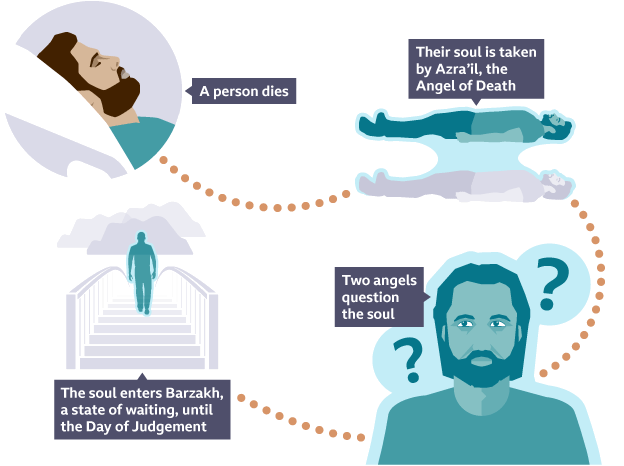
After death, most Muslims believe that the soul will enter Barzakh, a state of waiting, until the Day of Judgement.
- When a person dies, their soul is taken by Azra'il, the Angel of Death.
- Allah . . . sends two angels to question the waiting soul.
- If the questions are answered correctly, the
good soul then sleeps during Barzakh.
- If the questions are not answered correctly,
the soul is tormented by angels, known as punishment of the grave.
Heaven and Hell
Heaven is described in the Qur’an as a beautiful garden. Jannah is Paradise, where
those . . . who have been good . . . go.
It is described in the Qur’an as “gardens of pleasure” (Qur’an
31:8).
Muslims believe they get to Paradise by living religiously,
asking Allah for forgiveness and showing good actions in their life. These good
actions will be rewarded on the Last Day. Therefore, obeying the rules set by
Allah is of ultimate importance.
Muslims further believe that there are 7 levels of Heaven,
although “seven” is interpreted by some Muslims as simply “many”. Each Heaven is made of a different material,
and a different prophet lives in each Heaven. The 1st Heaven is made of silver and is
where Adam and Eve live. Abraham lives
in the 7th Heaven in a place made of divine light.
Hell (Jahannam) is described as a place of fire and
torment . . . a place of scorching pits of fire and boiling water . . . a place
of physical and spiritual suffering.
Vivid descriptions of Hell (Jahannam) are used in the Qur’an as a
way to stop Muslims from participating in sin.
Muslims believe that they will be sent to Hell (Jahannam)
if they reject the teachings of the Qur’an or take no responsibility for their
actions. Either of these would mean that
they had failed Allah’s test.
Some Muslims also believe that even the souls in Jahannam
can eventually be sent to Jannah (Paradise).
These beliefs give Muslims the motivation to follow the teachings in the Qur’an. They also give hope to those who suffer in this life that there is something better to come in the future.
ALLAH’s
Judgement
Yawm ad-Din is the Day of Judgement, when Allah will decide how people
will spend their afterlife.
Most Muslims believe they have free will to make their own
choices and that . . . they will be judged by God for those choices. They recognise that humans are still
responsible for their actions.
When Allah’s purpose for the Universe has been fulfilled, the
World will be destroyed.
Just when that comes to pass . . . Israfil will
sound a trumpet and there will be a resurrection and all the dead bodies
will be raised and will gather on the plain of Arafat for the
final judgement.
All the raised dead will be naked so that nothing can be hidden
. . . and each will be given their own 'book of deeds' to read aloud from
. . . in turns . . . so that nothing can be hidden.
In Islam – even non-Muslims (?) – will be judged at the Day of
Judgement with a Set of Scales balancing each one’s good and bad deeds.

For one whose scales are heavy with
good deeds . . . He will be in a
pleasant life – but, for one whose scales are light . . . His refuge will be abyss (Qur’an
101:6-9).
Those who are handed their deeds in
their right hand will go to Jennah (Paradise) . . . and those who are handed them in their left
hand will go to Jahannam (Hell).
Thus . . . with such heavy punishments or rewards . . . the idea
of a Day of Judgement encourages all Muslims to live their lives in a good way
and . . . to try and pass ‘Allah’s test of life’ by taking
responsibility for their actions, whether good or bad.
Muslims can also
ask for forgiveness and they recognise that intention is
important. For example, if a person
carries out an action because they intend the result to be good but the outcome
is unexpectedly bad - a good deed will still have been done as the intention
was good.